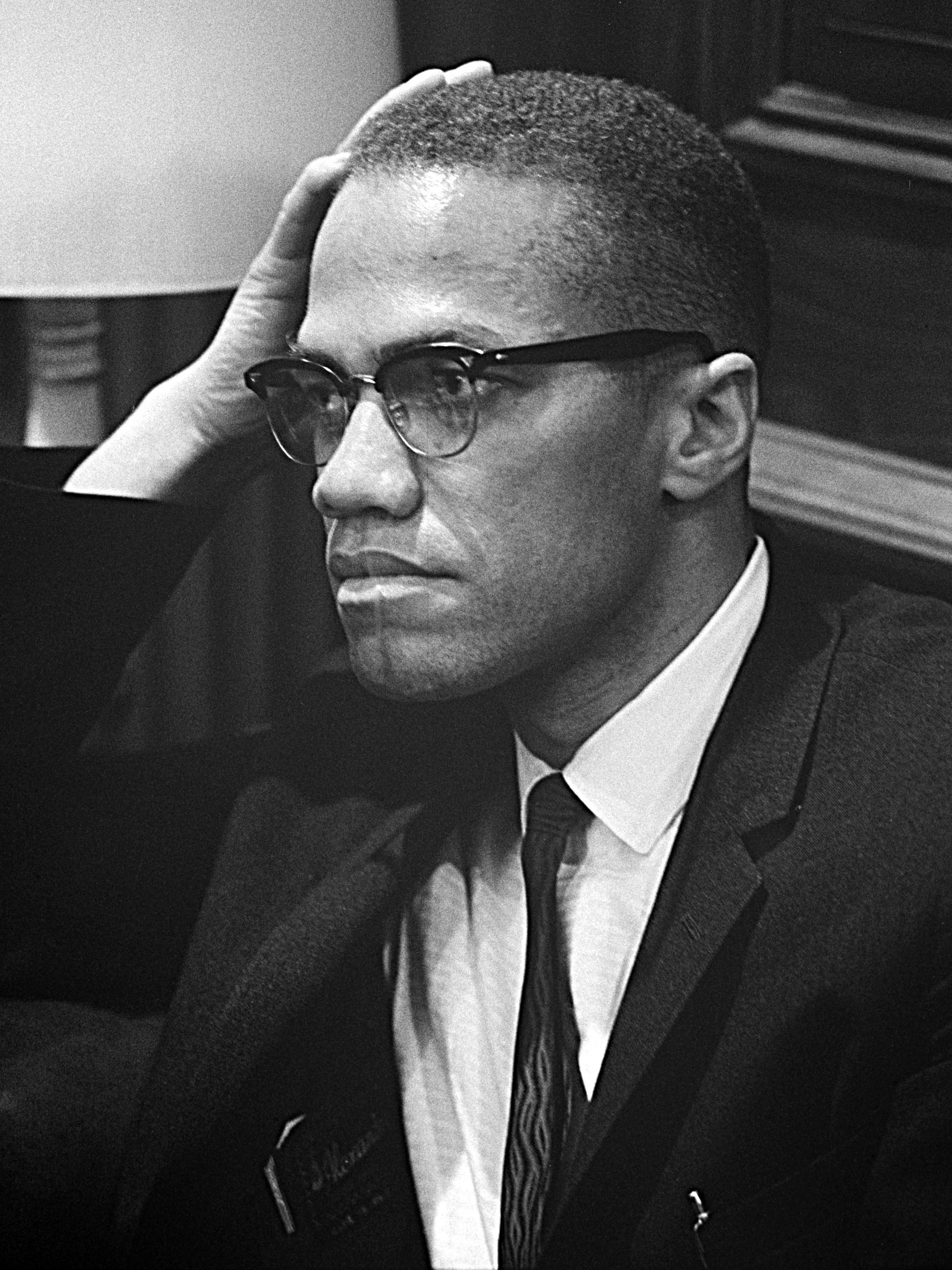
The complexities and paradoxes of Harlem can be partially understood through the kaleidoscope of the life and work of (Mr.) Malcolm X, with close reference to James Baldwin’s The Fire Next Time and Claude Brown’s Manchild In The Promised Land. It is my intention to demonstrate this by dividing the characteristics of Harlem into explaining four fundamental concepts: Harlem as a place with a pre-determined destiny due to geographical elements; Harlem as a space for change under the umbrella of democracy in the United States, being itself a microcosm of a black metropolis for the world’s black people; Harlem as a space where forces of good and evil co-exist and collide in a ghettoised prism, resulting in the notion of ‘good’ being heavily distorted; and finally Harlem as the white man’s ‘sleaze pit’ where white persons go to indulge in illicit customs. In the following essay it is my intention to illustrate how Harlem, when considered in these guises, and contextualised historically from 1940 through the 1960’s, changed Malcolm X from a naïve Michigan boy to a hustling, street-talking Harlemite, and then to a leader for the black community. Throughout, I will draw upon specific details given in the above texts.
GEOGRAPHICS
To begin, it is important to understand the significance of the geography of Harlem. In broad terms, this means placing the neighbourhood in relation to the rest of Manhattan. Harlem is located directly north of Central Park, with 110th street being the southern ‘dividing line’. Malcolm X noted in his autobiography that “when we left Central Park at the upper end, at 110th street, the people’s complexion began to change.” Indeed, 110th street was, during Malcolm X’s lifetime at least, a definitive barrier between classes and races. It is less so today, but it remains a significant point of reference on the majority of Manhattan maps. It should not surprise us in the least that Malcolm felt a change in the air when he crossed 110th street. We may be surprised, however, to read that around 110th Street was “the worst of the ghetto, the poorest people.” Even within the Harlem ghetto, a hierarchy remained.
While Harlem is basically a single borough, its streets are what New York’s African-Americans call (or are supposed to accept as) home. At the age of thirteen, James Baldwin learnt this from a police officer in the centre of the intersection: “the cop in the middle of the street muttered ‘why don’t you niggers stay uptown where you belong?’” it is significant that Harlem is quite central on Manhattan; to the East and West of Central Park to the South, Harlem is bordered by predominantly white neighbourhoods, and Washington Heights is to the North of the black community. Excepting Central Park, Harlem is completely surrounded by white boroughs, full of people with different coloured skin and people of a supposed different class. The captivity of the black man in the United States is certainly evidenced by these geographic idiosyncrasies, which all add to the experience of living in Harlem, and must be taken into account as having a positive effect in reinforcing the Nation of Islam ideology. Even Baldwin concedes that “it is ‘only the so called American-Negro’ who remains trapped, disinherited, and despised, in a nation that has kept him in bondage for over four hundred years. . .” Indeed, the location of Harlem could be one of the principle reasons for Claude Brown referring to Harlem as being “exploited and neglected.”
The grid system played an important part in the development of Malcolm X. The logistics of such a system results in the creation of a series of generic corners. At busy intersections, the corners become a focal point. Baldwin notes how he: “sometimes found myself in Harlem on Saturday nights, and I stood in the crowds at 125th Street and Seventh Avenue, and listened to the Muslim speakers.” The Nation of Islam speakers were not the only ones who preached on soapboxes and step-ladders at the bustling intersections to anyone who would listen. Malcolm X realised this:
. . . the big trouble, obviously, was that we were only one among the many voices of black discontent on every busy Harlem corner. The different Nationalist groups, the ‘Buy Black!’ forces, and others like that; dozens of their step-ladder orators were trying to increase their followings.”
We can see from this that the grid system in place across Manhattan Island allows speakers to address a large number of people at once. Citizens can congregate and listen, and the orators also have the chance of catching the ear of passers-by as well. The manipulation of geography within the urban spectrum helped Malcolm X when he was the hustler selling cannabis to the drug addicts. When he had come out of prison, he used the same locations to sell his story of the white man being the devil to the dishomed African-Americans who now occupied the ghettos of America’s metropolises.
A SPACE FOR CHANGE
It is possible to understand Harlem as an urban space for change under the umbrella of democracy, on account of it being a focal point for black people across the world. This is evidenced in the writing of Claude Brown, who not only insists that “to me, New York was Harlem,” but also says he “used to tell everybody jokingly - but I half believed it - that Harlem was the capital of the world.” Not only does this explain Malcolm X’s desire to go and experience Harlem, but it underlines the importance of the borough to African-American culture. Harlem gave African-Americans a sense of identity; this is reinforced by Brown’s notion that Harlem was still his “point of relating to life and events and putting them together.”
Considering this, we can apply a similar theory to the hustling of Malcolm X. He managed to sell marijuana all up and down the East coast of the United States, through the manipulation of a railroad identification card. When he ran out of supplies, he would return to New York (Harlem), load up and then hit the road again. Harlem became his base for his operation. It was his personal starting point for what he expected to be his life’s work. In a more general sense, this a reflection on the African-American relationship to the borough.
The notion of Harlem being the black man’s America is one which does not sit comfortably with the young James Baldwin. Throughout the opening part of The Fire Next Time, he feels sickened by the gangster lifestyle which was evident on a day-to-day basis on the Harlem streets. This is important because it is the opposite view taken by Malcolm X and Claude Brown who, for a short time at least, enjoy the characteristics of Harlem living in the age of sin:
“I was icily determined - more determined, really, than I then knew - never to make my piece with the ghetto but to die and go to hell before . . . I would ‘accept’ my place in this Republic.”
His anger at the misdemeanours of life on the Harlem streets is later adopted by both Brown and, to a greater extent, Malcolm X, yet his initial unwillingness to live out the gangster lifestyle even for a short time indicates that, for all it’s lacking of moral standards, Harlem can a place to empower the individual. In the case of Baldwin, it drove him into the church and made him a better person for it. Baldwin freely admits he was scared to be living in such close proximity to so many evils, but this made him starkly aware of what was right. Malcolm X (and to a lesser extent Claude Brown) gain this awareness only after having been sucked into Harlem’s seedy underworld (though a great many things happened in broad daylight) and gained first hand experience of life without morals.
Any urban space has the ability to change any man in any number of ways. The specific characteristics of Harlem life clearly result in everyone being someone, and Baldwin seems quite resigned to the fact that change happens in Harlem, and change happens fast. In his words, “one doesn’t, in Harlem, long remain standing on any auction block” before the nuances of life in the borough change your outlook on life and your personality. They changed Baldwin for the better, as they did Brown and Malcolm too, but only after years of experience of the nuances.
GOOD VERSUS EVIL
Certain characteristics of the Manhattan neighbourhood point to it being a space where forces of good and evil co-exist and collide in a ghettoized prism, and where the notion of good is distorted. Running the numbers, for example, is represented by Malcolm (and others) as being an accepted part of Harlem life: all citizens recognise it as being a relief from the stresses of living in the ghetto and most African-Americans dreamt of hitting the big combination one day. The police, for what they were worth, turned a blind eye to the numbers runners and allowed the practice to flourish. This all went on regardless of the fact gambling was deemed wrong by New York law, hence it being illegality.
This distortion as far as the characteristics of acceptability are concerned is paralleled by a greater sense of what is unacceptable. Claude Brown, for instance, remarks how stealing from the poor is utterly wrong when a numbers banker failed to pay out after a win.
What is good and what is wrong is very different within the Harlem ghetto. Streetcorner philosophers appear on the corner of many busy intersections appealing to Harlemites to listen to them and believe in what they are saying. Baldwin takes a distanced approach to such street politics:
“I have long had a very definite tendency to tune out the moment I come anywhere near either a pulpit or a soapbox. What … men were saying about white people I had often heard before.”
What Baldwin is referring to as “often heard before” is the berating of the white man. The portrayal of the white man as the devil would not have been anything new to any Harlemite. Malcolm X would soon be one of the people maximising the cosmopolitan way of life in Harlem in such a way in an attempt to try and get his political message across, but the acceptability of that political message outside of the 110th Street to 155th Street microclimate is unquestionably going to endure a harsh reception.
To reduce it to a lower common denominator, black is portrayed as good, while white is portrayed as evil. Baldwin notes how, to the supporters of the Nation of Islam at least, “Allah, out of power, and on the dark side of heaven, had become – for all practical purposes, anyway – black.” For Brown, being as far away from light skinned, the more accepted you were into the Harlem community, as if having a darker shade of skin made you a better person than a lighter skinned counterpart. Such assumptions and such warped values were acceptable and sustained in the Harlem which moulded Malcolm X, though they would most likely not be actively endorsed by people of authority and power.
SLEAZE PIT
The evils of Harlem made the area between 110th Street and Washington Heights into one big market. The market catered for the white man, and it is possible to understand Harlem as the white man’s ‘sleaze pit’, selling all the evils one can handle.
The young Malcolm X did not take long to notice that white people were not a novelty in Harlem; as he put it, “blacktown crawled with white people.” As he grew to know Harlem a little better, he slowly realised they came for the atmosphere: Harlem was a special place for them, too. Though Malcolm came close to white people early on during his time in Harlem (the NYPD recommended Small’s (where he worked) to white people looking for a ‘safe’ place up in Harlem), he would later come to know ‘sinful’ as being all too good a synonym for ‘white’.
The riot of 1943 had a detrimental impact upon Harlem being a fun place for white people from downtown. After 1943, few whites went North of Central Park after dark, preferring to get their kicks in other areas of Manhattan. The only white people who continued to go there after dark were in pursuit of illegalities.
With substantial amounts of money involved, Malcolm X played a part in helping rich white men (and thus usually powerful and important white men) live out their bizarre sexual fantasies. The women who ran the operation now needed ‘steerers’ to get her white clients into, and out of, Harlem without them being seen; this is where Malcolm came in. His first hand experience of this business resulting in him declaring “Harlem was their sin-den, their fleshpot.”
Interestingly, he notes that, in this black-white nether world, no one ever judged the white men. Later, however, Malcolm X would realise the errors he had made in his life, and as he became detached form the Harlem hustling scene, it is likely he would develop a very low opinion of the political leaders and the leaders of society whom he dealt with. To deny these experiences of white New Yorkers had a detrimental affect on Malcolm X is foolishness; he was often invited in by the white men to watch the whippings they craved from the African-American women. These experiences must partly explain his deepest feelings towards white people when he first left prison a Muslim. As James Baldwin noted: “the Negro’s experience of the white world cannot possibly create in him any respect for the standards by which the white world claims to live.”
The transparency of these exchanges is debatable. The chances are that tails of these services being provided by African-American women for (often ageing) white men slipped out into common knowledge somewhere down the line, whether it be by word of mouth or a passer-by seeing something odd. If we take this into consideration, and combine it with some hard facts, we get a detailed picture of the black-white relationship in Harlem during the given time frame:
Ø Authorities invested next to nothing in Harlem;
Ø Mayor LaGuardia closed the Savoy;
Ø Rents in Harlem were higher than most of the rest of Manhattan;
Ø White merchants in Harlem refused to hire black people;
Ø A white policemen shot a black soldier at the Braddock.
The latter two were the cause of the 1935 and 1943 riots respectively. If we take all these into consideration, we get a greater understanding of why Baldwin asserted that “one did not need to prove to a Harlem audience that all white men were devils.” In the work of Malcolm X with the Nation of Islam, we see this inherent belief, personified by incidents in the borough of Harlem, run explicitly through his work.
To conclude, by reading The Autobiography of Malcolm X in close relation to The Fire Next Time and Manchild of the Promised Land under the four guises outlined previous, we get a good sense of the urban landscape and the social make-up of the Harlem which transformed Malcolm X, first into a criminal, and then permitted him to be a devoted believer in the dangerous notion of the Nation of Islam: the white man is the devil. It is important to understand both aspects of Malcolm X’s life to get a grasp of the paradoxes which were present in Harlem from (roughly) 1940 through the 1960’s and which can, and do, exist in any urban space.